Janu, Tokyo.
Stillness as a Discipline
Three nights at Janu, Aman's quieter sister in Azabudai Hills — and what a life in Bangkok learns from a city, and a hotel, built on absence.
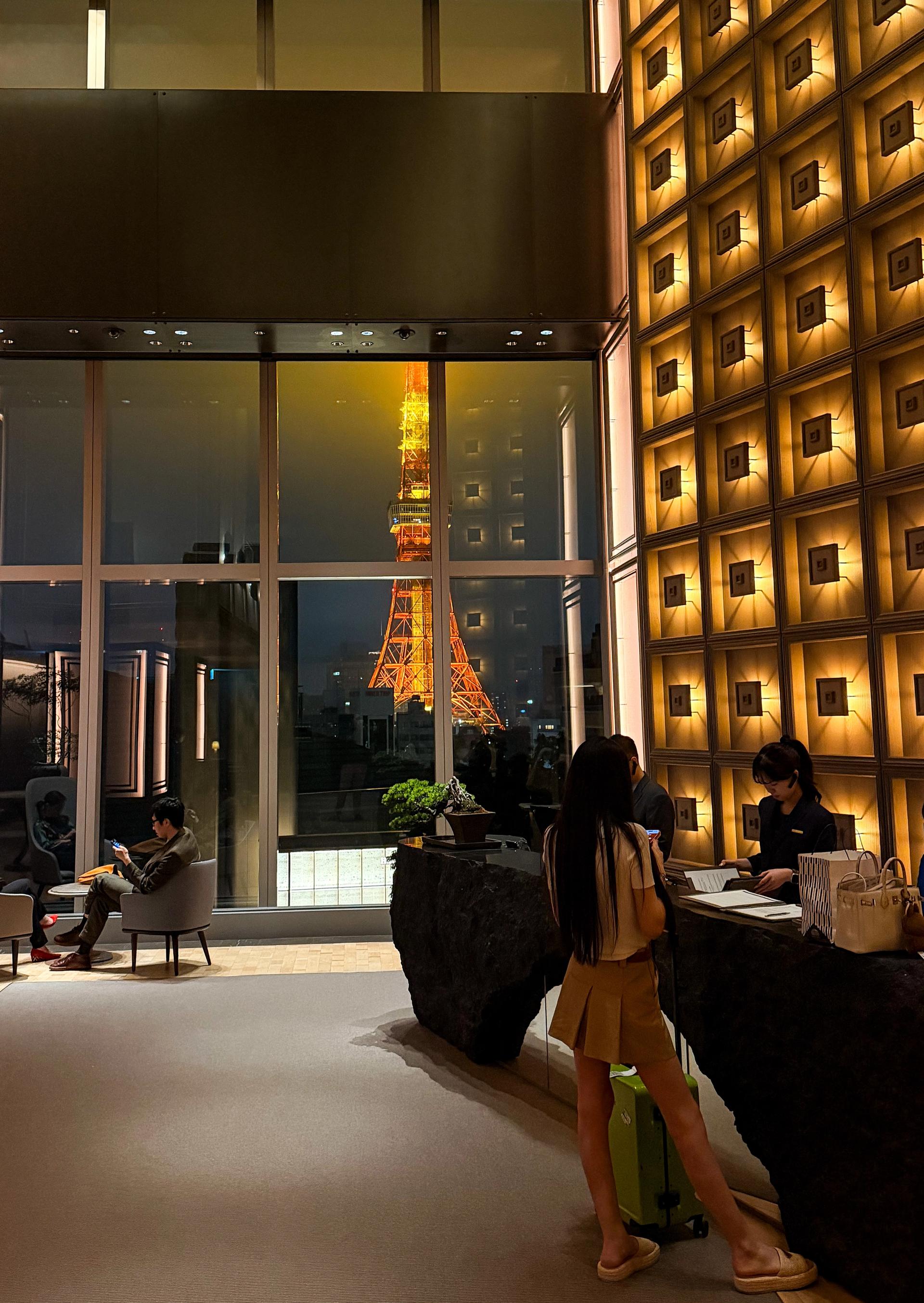
Tokyo had been on my list for most of my life - for the food, for the architecture, for ma, the Japanese idea that the empty part of a room does as much work as the full part. I flew up from Bangkok, where I live, and where emptiness is a rumour more than a principle. The two cities are opposites, and I went to feel the distance between them.
Janu makes the distance immediate. You arrive below ground, by car, and rise into a lobby that has decided you are no longer in the city you just left. This is Aman’s younger sister - the first property under the name, opened in spring 2024 - and it inherits the family restraint. It does not announce itself. The scent barely announces itself; the drink at the bar arrives correct the first time. The mood is low and dark, the Japan I had imagined long before I came: deep tones, quiet rooms, an atmosphere you feel on the skin. Our Premier Room was among the largest I have kept in years, with a terrace over the city, and it practised ma without saying the word - space left empty so the little that remained could be felt.
I should be honest about the city, because the hotel only makes sense against it. Tokyo is, for someone who lives in Bangkok, almost too clean and far too sure of itself. The best tables are booked weeks out, and if you are five minutes late they give yours away. I spent a slow hour in Pace, the gallery beside the hotel, and the precision began to read less like rigidity than like care - the same care Janu runs on, turned outward on a whole society.
Most of what I saw I owe to Tatsumi, on the concierge desk. Her matcha and ramen lists were a real map of the city, annotated by someone who clearly ate. She sent me to Ginza Kagari, a hole in the wall with a queue and some of the best ramen anywhere, and to Sushi Ojima for an omakase I am still thinking about. Next door she pointed me to the Kenzo Estate bar - a Japanese winemaker who grows in Napa and pours things that never leave the country. Even breakfast is considered: two rooms, two moods, one for whichever version of the morning you want.
Janu is not for everyone, and it is better for admitting it. It is built for people who want for nothing and perform nothing. Not the traveller collecting rooms, nor the one who needs the restaurant to watch them arrive, but the person who already has everything except stillness and the time to return to it. The hotel is designed around that absence of need. It asks nothing of you and stages nothing for you, and it will not bend for a vice: if you smoke, the whole complex offers you one cramped room or a long walk out of the building, and the terrace, beautiful as it is, is for breathing and little else. It knows exactly the life it is built around, and leaves the rest out. This is, more or less, the person we design for - which is why Janu reads to me as a building-sized version of a Liminal journey: the threshold crossed quietly, the noise left on the far side of the door.
The wellness floors are really four - some 4,000 square metres, among the largest in the city. A 25-metre pool, seven treatment rooms, a hydrotherapy circuit with hammam and Banya, and an onsen as good as any I can name. You choose between a robe and a yukata; cold water waits everywhere. But the room I keep returning to is the gym. It is enormous and never crowded, dark-toned, the cityscape laid out through the glass - a boxing ring in its own room, a golf simulator, studios for reformer Pilates and private sessions. I have trained in a lot of hotels. I have never seen one treat the gym as something to be proud of rather than hide.
What Tokyo gives you is exuberance. What Janu gives you is the opposite, and the reason to go. You step off the street and the city lets go of you - not muffled but gone, the way it goes when the right door closes. The pull of a place like this is easy to misread as wanting more: another fine room for the list. It is the opposite. You leave owning nothing. You leave with less - the noise set down somewhere below you, the city held at a volume you can choose.
- Max, Founder